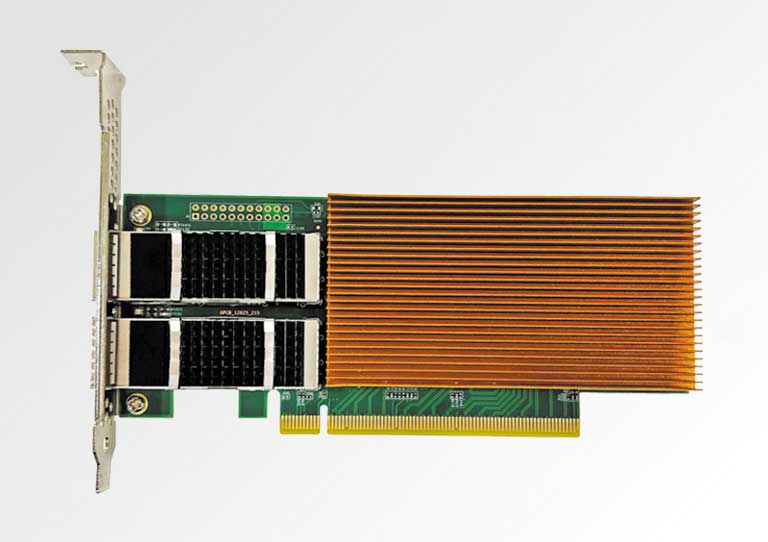
At 100 gigabits per second the adapter stops being a commodity and becomes part of the system design: PCIe lane budget, latency behaviour and failure modes all show up in application performance. GRT fields three 100G adapters, each aimed at a different job.
All three present dual 100G ports. Two of them document their host interface in full: the bypass model and the G810 model are both PCI-Express 4.0 x16 cards. The standard model is likewise a dual-port adapter, but its slot and module details follow its current datasheet, so our team will confirm them against your server when you inquire. The practical difference is what happens around the silicon: the bypass model adds watchdog-driven link protection for inline appliances; the G810 model replaces the controller with GRT silicon adapted to domestic CPU platforms and operating systems; the standard model is the straightforward high-throughput uplink for compute and storage nodes.
Planning a 100G upgrade
A 100G card is only as fast as the optics and fiber behind it. For runs beyond a few metres, the FF-1102E pairs with QSFP28 transceivers; DAC/AOC assemblies serve inside the rack. For the bypass and standard models, the optics form follows the datasheet of each model — our team can spec the complete link, card, module and cable, as one bill of materials.
What slot does a 100G card need?
The bypass and G810 models use PCI-Express 4.0 x16; confirm your server exposes a full x16 electrical slot, not only a mechanical one. For the standard E810 model, we confirm the slot requirement from the current datasheet with your inquiry.
Is RDMA supported?
The standard E810-based adapter supports RDMA, and low-latency behaviour is a design focus of the 100G tier. For RDMA-specific deployments, see our blog guide on RDMA and low-latency NICs.